Revisiting Fritz Lang's The Testament of Dr. Mabuse
The Testament of Dr. Mabuse (Das Testament des Dr. Mabuse) the last film of Fritz Lang’s first German career, was completed in 1933, a few months after the election of Adolf Hitler as Chancellor of Germany, and was immediately banned by Minister of Propaganda, Joseph Goebbels. Lang’s account of his meeting with Goebbels reads like a scenario for one of his own films, an encounter whose atmosphere of veiled prompted his decision to flee Germany the same night.1 However, examination of Lang’s passport revealed that he did not leave Germany until some months later, and Goebbel’s meticulous diary contains no mention of meeting with Lang.2 Lang later claimed the film was banned because it contained a thinly veiled attack on Nazi ideology. When Lang released a re-edited version of the film released in the New York City during the war he stated:
The film was made as an allegory to show Hitler’s processes of terrorism. Slogans and doctrines of the Third Reich have been put into the mouths of criminals in the film. Thus, I hoped to expose the masked Nazi theory of the necessity to deliberately destroy everything which is precious to a people.3
Even if Lang’s later accounts of the film’s reception by Nazi powers and his own claim for his intentions took on more dramatic tones, this does not reduce the film’s vivid evocation of the era of Nazi take-over or Lang’ (and his scriptwriter-wife Thea von Harbou) insight into the roots of Nazi ideology, albeit possibly not fully conscious. Lang has claimed he was just reaching political maturity when he made the film, while Von Harbou soon became a Nazi Party member and continued to work in the German film industry after she divorced the man she described as “the Jewish filmmaker” Fritz Lang. My own sense of The Testament’s continued relevance has only grown over the years. This short essay adds some of these reflections to the notes I wrote for the Criterion release of a DVD of the film.4
Let me begin with the manifesto Mabuse writes in his cell in Dr. Baum’s asylum which then becomes the blueprint for Baum’s campaign of terror.
Humanity’s soul must be shaken to its very depths, frightened by unfathomable and seemingly senseless crimes, crimes that benefit no one, whose only objective is to inspire fear and terror, because the ultimate purpose of crime is to establish the endless empire of crime, a state of complete insecurity and anarchy, founded upon the tainted ideals of a world doomed to annihilation. When humanity subjugated by the terror of crime has been driven insane by fear and horror and when chaos has become supreme law, then the time will have come for the Empire of Crime.5
The Evolution of Mabuse
In 1933, Fritz Lang gave these words to his visionary figure of a modern terrorist, Dr. Mabuse. If they seem eerily prophetic today, we must remember that Lang had a model close at hand: Adolf Hitler and the Third Reich, which had just seized power in Germany. One of the first acts of the Third Reich was to ban Lang’s yet-to-be-released film, The Testament of Dr. Mabuse. At that point, Lang felt his films were so popular in Germany that people would demand the ban be lifted. He soon found that he had underestimated the control the Nazis had gained over the film world. Although he claims Hitler’s minister of propaganda, Joseph Goebbels, approached him about becoming the head of German film, since Hitler loved Lang’s films, (a claim no one has ever verified), Lang realized he could no longer control his filmmaking in Germany and left the country, first for France, then for Hollywood.
While Dr. Mabuse may seem the image of Hitler, he predates the rise of the Nazis. Today he does not simply seem a figure from the past history, but a compellingly contemporary image of terrorism in an age of universal conspiracy and advanced technology. Lang had made his first film based on Mabuse in 1922 with his two-part masterpiece of silent filmmaking, Dr. Mabuse, the Gambler. Based on a character created by novelist Norbert Jacques, Mabuse was a master criminal who used disguise, blackmail, stock market manipulation and occult powers of hypnosis to deliver people into his control. He proclaimed, “There is only one thing that is interesting anymore: playing with people and their destinies.” Based on such earlier master criminals as Sir Arthur Conan Doyle’s Professor Moriarty and the French phantom bandit, Fantomas, Mabuse brought new, modern elements to the character of unstoppable evil through his role as a psychoanalyst and his occult powers of mind control.
Nearly a decade later Lang resurrected this figure, undoubtedly because of his uncanny prefiguring of the Nazi movement. But the Mabuse of Testament became a very different figure from the hypnotizing, metamorphosing criminal of the 1920s. At the end of the first film, Mabuse went mad as his empire of crime collapsed around him. Throughout Testament he remains a madman confined to an asylum, never speaking and seemingly unresponsive, but constantly writing sheaves of documents that plot the strategies of his empire of crime (an image of Hitler, confined after the failed Beer Hall Putsch, writing Mein Kampf?). Unable to do anything physical but write, Mabuse retains his power to control men’s minds, which he asserts over the asylum director, Dr. Baum (another sinister psychologist—Lang must have had anxieties about psychoanalysis!). Even after his death Mabuse controls Baum, who becomes seemingly possessed by the spirit of the master criminal and carries out his plans of terror.
The Possession of Dr. Baum
The sequence of Baum’s possession by the spirit of Mabuse provides one of Lang’s most bizarre sequences, a final tribute to the hallucinatory and Expressionistic silent cinema of the Weimar Republic. Lang confronts Baum with a transparent, soft-focused image of the dead Mabuse, his previously strange physiognomy now exaggerated in a bizarre mask with huge eyes, like a Sumerian idol. The words of Mabuse’s manifesto of crime and terror echo on the soundtrack, whispered in a thin, raspy voice. Lang intercuts the scene with primitive masks and Expressionist paintings (undoubtedly part of the large art collection that Lang had to leave behind in Germany when he emigrated). Mabuse doubles himself and merges with the figure of Baum, a powerful image of the rational mind undermined by obsession, fantasies of mastery overwhelming any impression of reality.
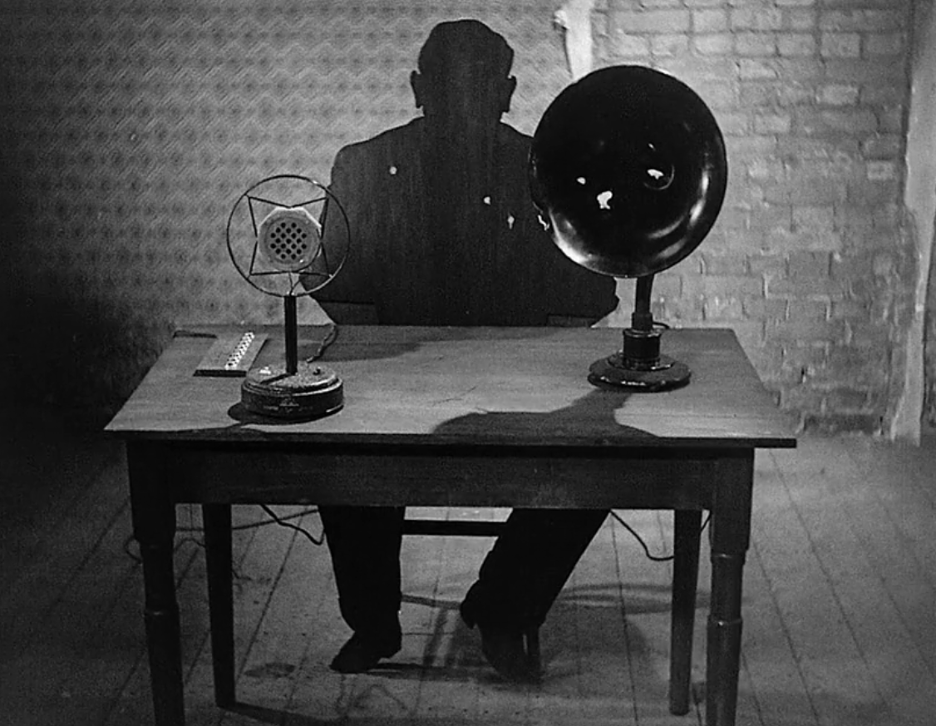
In place of the flesh-and-blood Mabuse of the earlier film who gambles in illegal casinos, romances women, and commits robberies and murders through his henchmen, in Testament Mabuse remains a shadowy, abstract figure who asserts his power through his ideas and plans, his power continuing (perhaps even growing) after his death. Mabuse is little more than a cardboard figure, the “man behind the curtain” who addresses the gang over a loudspeaker. Lang has moved the master criminal from the turn-of-the-century world of caped and hooded criminals into a modern world in which the greatest power of the terrorist lies in his invisibility and intangibility, which raises the question of whether he is alive or dead—and what difference does it make, anyway. Crimes become less actions undertaken for individual profit or revenge than the consequences of a seemingly abstract system. Mabuse, like the terrorists of today, thrives on the modern world of media and international networks. He is kept alive through the technological recordings and transmissions of his voice, delivering his messages while keeping his physical presence hidden, untraceable, and therefore unseizable.
Inspector Lohmann vs. Abstract Terror
Every master criminal finds his complement in the brilliant detective who pursues him (Sherlock Holmes for Moriarty, Inspector Juve for Fantomas). In Testament, Lang decided not to bring back Mabuse’s aristocratic opponent from Dr. Mabuse, the Gambler, Inspector von Wenk. Instead, he introduces the corpulent, working-class Inspector Lohmann from his previous film, M (1931). Lohmann’s everyday logic and down-to-earth suspicion stands in contrast to the fascination Mabuse exerts over Dr. Baum; Lohmann, a typical German detective, exhibits levelheaded professionalism and immersion in everyday pleasures that Lang might have seen as a counterbalance to the mystification and dark fascination of the Nazi ideology.
Chomping on cigars, catching naps in his office, trying to sneak off to the opera, Lohmann remains nonetheless rooted in logic and scientific investigation. But in pursuing this new criminal conspiracy he has very little to go on: a staring madman, interrupted phone calls, fragmentary messages, and a labyrinth of connections that seem to circle around a single name: Mabuse. Lohmann encounters this name repeatedly and, aware that it comes from the past, searches the archives for old police records (or is it the studio archives for the script of Lang’s previous film?). Maintaining his sanity while those around him lose theirs, Lohmann tries to pry out the significance of this name. But when he finally identifies the perpetrator, Dr. Baum, the psychologist has become like the actual Dr. Mabuse at the beginning of the film: a madman who stares blankly in front of him. Baum ends up imprisoned in one of the cells of his own asylum, but is the cycle of madness and crime really over? As the door shuts on his cell, the film comes full circle, with madness confined but by no means terminated.
Lang’s Mastery of Sound
One cannot leave this complex film without discussing Lang’s own mastery of one of cinema’s newer devices in 1933: sound. Two years earlier, in his masterpiece, M, Lang created one of the first enduring masterworks of film sound. From its very first images and sounds, The Testament of Dr. Mabuse continues Lang’s experiments with the role sound could play in creating suspense and terror. As the camera prowls about an old attic, discovering police agent Hofmeister spying on Mabuse’s gang, we hear a deafening mechanical pounding on the soundtrack, that seems to shake the very foundations of the set. This overwhelming noise makes dialogue impossible. The source of the opening din is never shown (presumably a printing press manufacturing counterfeit currency) but remains an aural image of the system of terror Mabuse is putting in place. As Hofmeister sneaks out of the building, Lang builds another succession of threatening sounds: the engine of a passing truck, the crashing of a piece of masonry that barely misses him, then the rolling of an oil barrel down a ramp, where it explodes in flames.
(Following a pattern of rhyming sounds or bits of dialogue from scene to scene, the next sound we hear after this burst of flames is Lohmann’s voice declaring, “Fire magic!” as he evokes the Wagner opera he is about to attend.) Lang understood that the sound film should actually be a film of sounds, not simply a talkie, a viewpoint evident also in the initially comical but ultimately deadly chorus of sputtering motors and atonal, syncopated car horns that covers the murder of Dr. Kramm.
A Contemporary Nightmare Vision
A nightmare vision of a modern world gone mad, of the effect of terror on society, a final tribute to the Expressionistic German cinema, an early example of the unique effect of film sound, and a powerful detective thriller, The Testament of Dr. Mabuse remains one of Fritz Lang’s most complex films. Restored now to its original visual and aural power, it should be enjoyed and studied, both for what it teaches us about the expressive nature of cinema—and the terrors of modern life.
Contemporary Connections
Not long after I wrote these notes for Criterion, I collaborated with my friend Travis Preston on a production of a play which he directed entitled Fantomas: The Revenge of the Image which was produced in Wuzhen, China in 2016 just before the COVID era. Drawing on Feuillade’s series of films and their source, the novels by Pierre Souvestre and Marcel Allain, which chronicled the crimes of Fantomas, our production aspired to reflect on the specter of terrorism which Fantomas cast at the beginning of the twentieth century. (For two excerpts, see here and here.) The first novel of the series began (as did our production) with this exchange between by two unidentified voices.
“Fantomas.”
“What did you say?”
“I said: Fantomas”
“And what does that mean?”
“Nothing… Everything!”
“But who is this ‘Fantômas’?”
“Nobody… and yet, yes, it is somebody!”
“And what does this somebody do?”
“Spreads terror…“6
While many adaptations of the crime fiction of this era (including Georges Franju’s fine version of Feuillade’s Judex (1964)) cultivate a nostalgic irony, Preston was determined that our production not lose the novel’s atmosphere of nameless terror. We decided our production would trace an arc from the more limited threats of Fantomas and his gang to the global sense of terror invoked by Mabuse’ manifesto and Lang’s understanding of Mabuse as the harbinger of Hitler. As we worked on the piece in the era of the rise of ISIS, it struck me that Mabuse’s manifesto seemed to predict the work which the Islamic State saw as announcing their own caliphate of terror, The Management of Savagery: The Most Critical Stage Through Which the Umma Will Pass written by Abu Bakr Naji. This manifesto of modern Jihad, according to Jeff Solen of the Mackenzie Institute in Canada, was “widely embraced by Islamic State (IS) senior leaders as a blueprint for their barbarous acts and intended plans for the establishment of a caliphate.”7 Our image of the black clad and hooded Fantomas merged with the images of ISIS operatives similarly hooded in black as they beheaded their victims on video.
Since that time the image of terrorism and the response to it has become not only more omnipresent, but more complex and perhaps taken on a new tone. More than the Mabuse films, contemporary reality recalls the finale of Lang’s Mabuse-like thriller Spione (1928). At the climax of Spione, Haghi the master spy (who, like Mabuse, has multiple avatars) is revealed as the music hall clown Grok, his more sinister identity disguised by greasepaint, baggy pant and a false wig. In the midst of his act Grok sees the police waiting for him in the theater wings and realizes he has been unmasked. He continues his comic performance as, laughing maniacally, he aims a revolver at his head. He fires to the hilarious applause of the audience, as the curtain comes down and the film ends. This finale seems to realize one of Soren Kierkegaard’s Diapsalmata in Volume One of Either/Or, which describes a clown trying to convince an audience that his announcement that the theater has caught fire is not a joke. Kierkegaard commented, “this is the way, I suppose, that the world will be destroyed, amid the universal hilarity of wits and wags who think it is all a joke.”8
Who’s laughing now?
Footnotes
1 Lang’s dramatic account was recorded in Mark Shivas, “Fritz Lang Talks about Dr. Mabuse” reprinted in Andrew Sarris, Interviews with Film Directors (Indianapolis: Bobbs Merrill, 1967), p.260.
2 The passport was acquired after Lang’s death by the Siftung Deutsche Kinemathek in Berlin. The revision of Lang’s account is in Patrick McGilligan, Fritz Lang, the Nature of the Beast: A Biography (New York: St. Martin’s Press, 1997), p. 178-79.
3 Fritz Lang, theater program note for showing of The Testament of Dr. Mabuse at The World Theater NYC, March 19, 1943, quoted in Siegfried Kracauer, From Caligari to Hitler: A Psychological History of the German Film (London: Dennis Dobson, 1947), p. 248.
4 I originally wrote the notes for the Criterion DVD edition in 2001. I thank Criterion for permission to reprint it.
5 Voice-over from The Testament of Dr. Mabuse script by Fritz Lang and Thea von Harbou.
6 Pierre Souvestre and Marcel Allain, Fantomas (New York; William Morris and Company, 1987) p.11.
7 Source: https://mackenzieinstitute.com/2016/06/management-of-savagery-a-model-for-establishing-the-islamic-state/. Viewed on August 14, 2025.
8 Soren Kierkegaard, Either/Or Part I, “Diapsalmata”, p. 30.