The Joyless Street – An Endless Story
Die freudlose Gasse (The Joyless Street/La rue sans joie)
Germany, 1925
Directed by Georg Wilhelm Pabst
Written by Willy Haas, based on the novel by Hugo Bettauer
Cinematography by Guido Seeber, Curt Oertel, Walter Robert Lach
Set design by Hans Sohnle, Otto Erdmann
Edited by Mark Sorkin
Cast: Greta Garbo (Grete Rumford), Asta Nielsen (Marie Lechner), Agnes Esterhazy (Regina Rosenow), Hertha von Walther (Else), Tamara (Lia Leid), Valeska Gert (Mrs. Greifer), Werner Krauß (Josef Geiringer)
Produced and distributed by Sofar-Film-Produktion GmbH, Berlin
Premiere: May 18, 1925, Mozartsaal Berlin
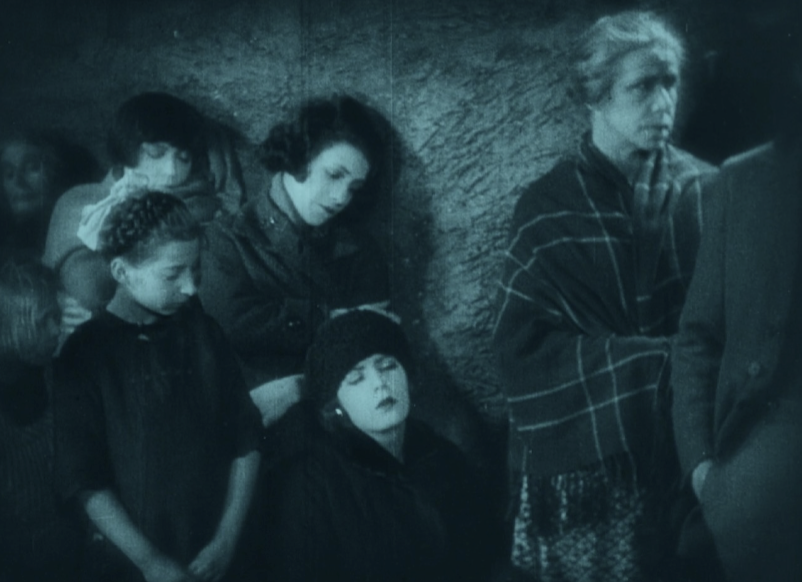
G.W. Pabst’s The Joyless Street is one of the great classics of German silent cinema. At the same time, it is also one of the most severely mutilated works in film history, disfigured by film dealers, distributors, and censorship interventions, and today it can no longer be fully reconstructed. Missing production and censorship documents leave many details of its genesis in the dark and encourage unfounded legal claims and disputes that continue to hinder the film’s distribution.1 For more than forty years, the Munich Filmmuseum has been working to produce the most authentic version possible—a Sisyphean task that raises more questions than it can definitively resolve.
G.W. Pabst (1885-1967) came to film via the theater and had proven himself as a director and dramaturg before entering film production with Carl Froelich. He directed two feature films: Der Schatz (1923) for “Froelich-Filmproduktion” and Gräfin Donelli (1924) for “Henny-Porten-Filmproduktion.” Allegedly, he declined an offer to continue working for Porten and sought new challenges. Through the mediation of Marc Sorkin (1902–1986), whom he had met as an assistant director during shooting, he came into contact with Michael Salkind (1892–1974). The émigré Russian2—trained as a lawyer and at one time director of the opera in Leningrad—tried his hand at trading in a wide variety of goods. In Berlin, on September 14, 1922, with capital of 400,000 marks, he registered the “Gesa-Handelsgesellschaft für sanitäre Einrichtungen GmbH,” whose business involved the distribution of furnishings for hospitals and sanatoria, as well as import and export in related industries.3 At the end of 1924 in Paris, together with the Latvian-born Romain Pines (1890-1981), he founded “Société Zalkind et Compagnie,” active broadly in film trading.4
When Salkind searched for a financier for a Pabst film, Pines put him in touch with Moïse Zlatopolsky (1884–1956), whose father, the Zionist activist Hillel Zlatopolsky (1865–1932), had successfully invested in the sugar industry.5 Like Salkind, the Zlatopolskys held interests in several companies, including “Omnium d’industrie sucrière et agricole,” whose business ranged widely—from stationary engines and balloon envelopes to beet seeds, cinema, and mechanical construction—with varying degrees of success.6 Zlatopolsky was prepared to provide $40,000 for a film adaptation of Salomon An-ski’s play The Dybbuk.7 He had known the author from before the Russian Revolution, when An-ski presented the play at his home in Leningrad.8 According to Michael Pabst, his father worked for months preparing the film Dybbuk. Various screenplay drafts survive.9
Sorkin claims to have drawn Pabst’s attention at the same time to the novel Die freudlose Gasse, which appeared in 58 installments in the daily newspaper Der Tag between October 18 and December 16, 1923. When published in book form on January 9, 1924,10 the first edition sold out within a week; within a few weeks, circulation reached 30,000 copies.11 Hugo Bettauer’s panorama of society, published at the height of inflation, struck a nerve. Even reviewers who granted the novel little literary merit felt it practically cried out for film adaptation.12
On June 7, 1924, Der Filmbote announced a planned adaptation by the Munich production company “Orbis-Film.” 13 Its director Kleinlein stated that dramaturg Reinhold Eichacker was preparing the adaptation.14 Apparently, however, he had not secured the rights from Bettauer, who confirmed to Pabst on October 17, 1924, that he alone held the film rights and that no other claims existed.15 According to Sorkin, Pabst could not pay the $2,000 licensing fee and secured only an option.16 When Pabst met Moïse Zlatopolsky in Paris on December 23, 1924, to sign the final contract for Dybbuk, he persuaded the financier instead to produce The Joyless Street, which could be realized with a smaller budget—and at the last moment replaced the title in the contract.
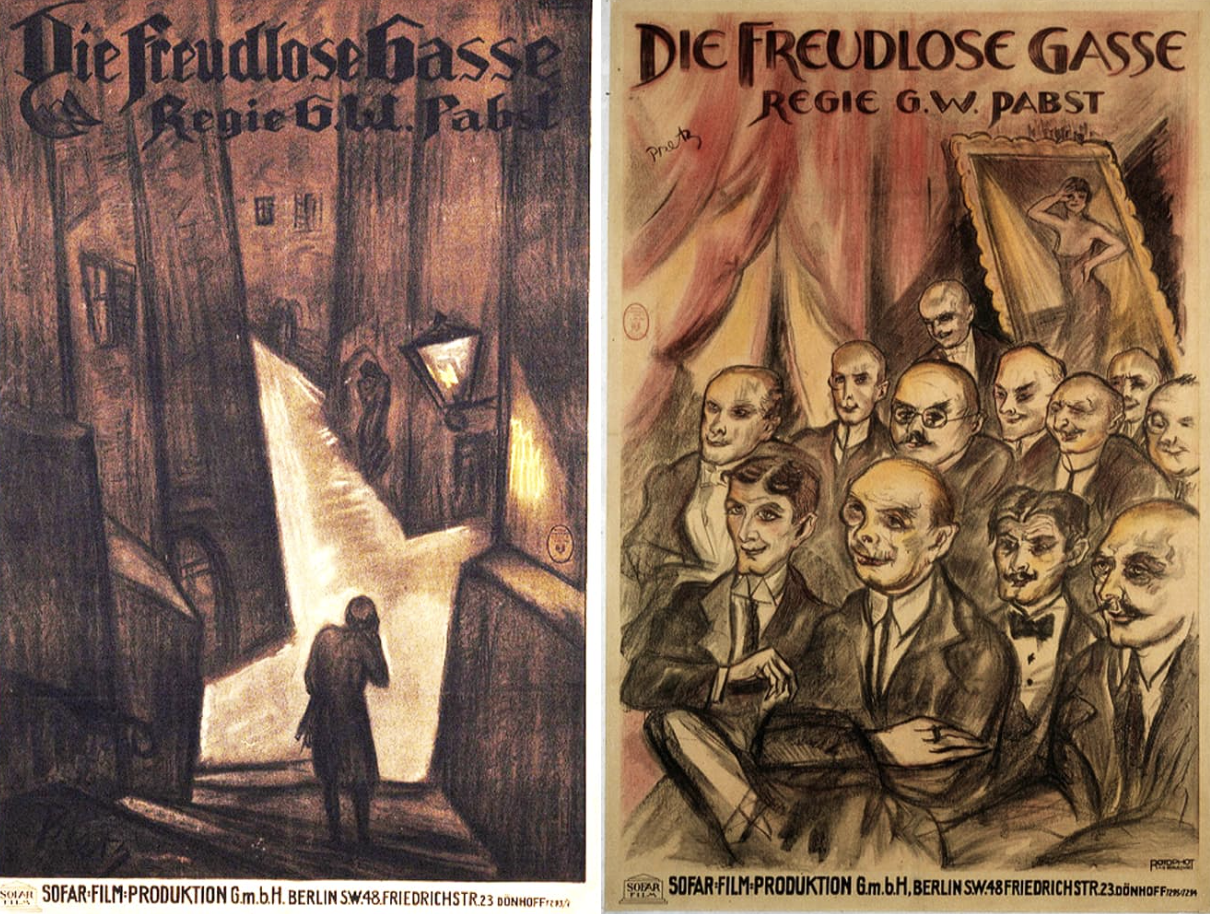
Production began immediately. Willy Haas wrote the screenplay in consultation with Pabst.17 He skillfully interwove the novel’s elements and stories, eliminated certain figures—such as the journalist Otto Demel, Bettauer’s alter ego—and added others, including two American officers and a butcher. Haas later recalled that what attracted Pabst was the glaring social image of inflation: the bankruptcy of established patrician civil servants and academics, corruption, and moral decay, as experienced in Berlin. They agreed the film should focus on the social dimension and downplay the criminal elements. Almost only the title would remain, which Pabst found attractive.18
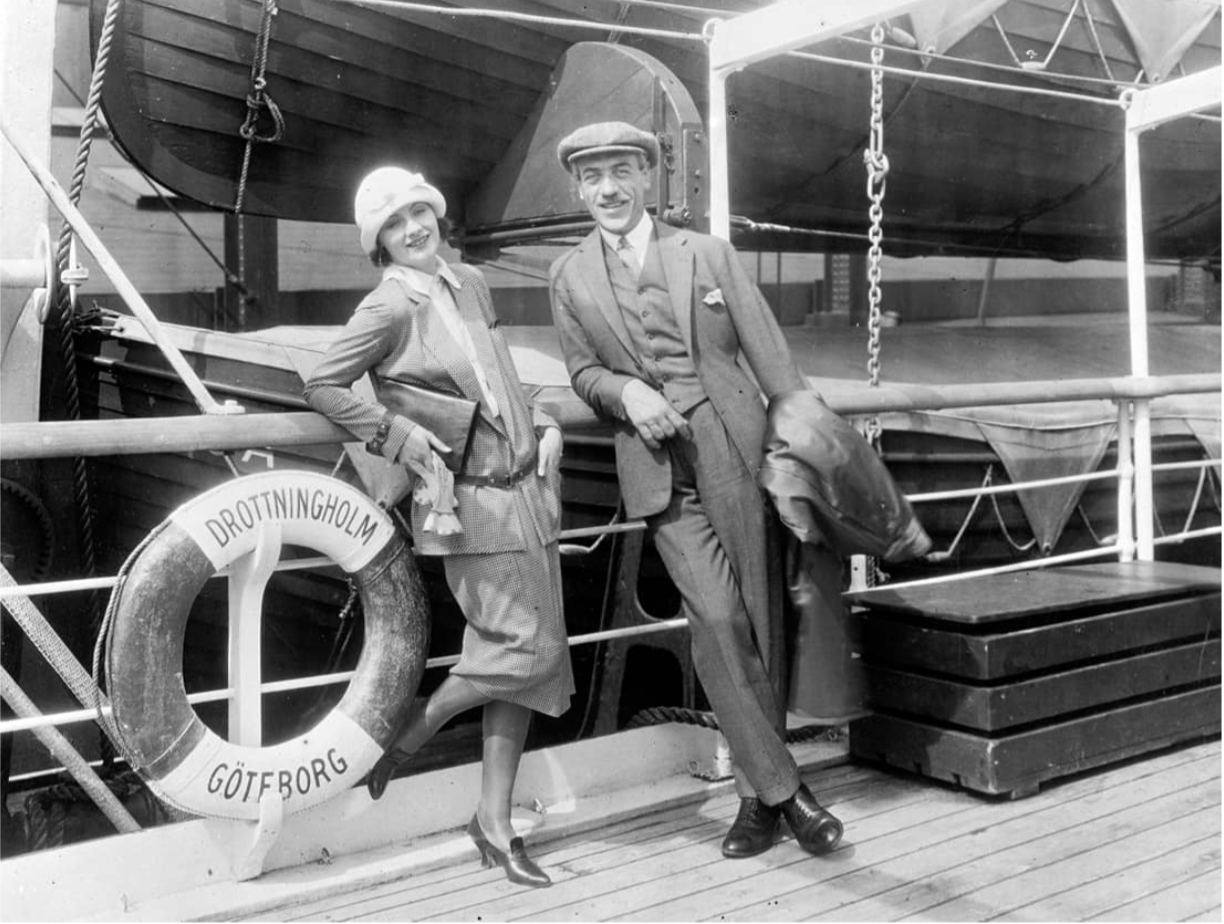
Greta Garbo and Mauritz Stiller in 1925 at their departure for America.
Pabst succeeded in securing major actors such as Asta Nielsen and Werner Krauss for unusually small roles. Haas commented dryly that there was plenty of money, and they could afford an “all-star cast.” Pabst scored a coup by casting Greta Garbo, who soon after achieved fame in Hollywood. Initially he had sought Vilma Bánky, who had already left for Hollywood. Pabst had seen Garbo in the Swedish film Gösta Berlings Saga (1924). Over New Year 1924/25 she was stranded at the Pera Palace Hotel in Constantinople after a German Trianon-Film project under Mauritz Stiller collapsed. Stiller negotiated Garbo’s contract with Pabst and ensured the casting of Einar Hanson.19 On January 26, 1925, Salkind and Pabst confirmed Garbo’s engagement for 15,000 Swedish crowns for shooting from February 12 to March 26, including an option for reshoots until March 30.20
Many roles were filled by Russian émigrés who had fled the Bolshevik Revolution and were scraping by in Berlin in jobs far below their former social standing. Each owned a tuxedo and top hat—and knew how to wear them. The same applied to the women, richly supplied with evening gowns, fur coats, and genuine jewelry.21 The press dryly noted: The film, the first work of a German-Russian-French combination, shows an international cast. All countries and continents are represented—except that in this Viennese film, Viennese actors and actrices are missing.22
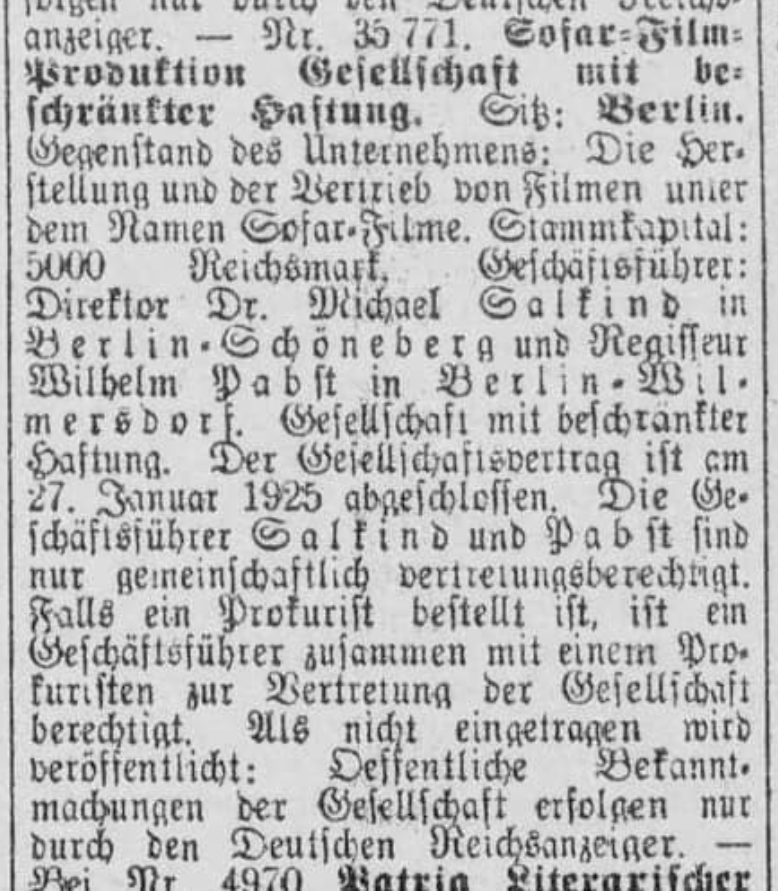
Deutscher Reichsanzeiger No. 70, Mar. 24, 1925
One day after Greta Garbo’s engagement, G.W. Pabst and Michael Salkind founded Sofar-Film-Produktion GmbH in Berlin on January 27, 1925. Shortly before that, Salkind had established in Paris the “Société des Films Artistiques” (Sofar), in which “Société Zalkind et Compagnie” held one-third of the shares. The company was intended to handle the distribution and release of artistic films. Moïse Zlatopolsky, serving at times as president and majority shareholder, chaired the first shareholder meetings of the French Sofar. The managing directors of the German Sofar were Pabst and Dr. Michael Salkind. Sorkin supported Pabst’s decision to create a separate production company: “Pabst formed a company in Germany (…) We could never have made Die freudlose Gasse if we hadn’t been independent. With the big companies it’s too much politics, and not enough movies.”23 In fact, Pabst succeeded in shaping the film as both director and producer, together with Sorkin, without interference from the financiers—who were still completely inexperienced in the film business.
Filming began two weeks after the company’s founding, on February 12. For smaller tasks, Pabst relied on family members and friends: his newlywed wife Gertrude was responsible for Garbo’s costumes; his brother-in-law Ernst Broda, his mother, and his friend Max Pretzfelder appeared in minor roles.24 His nephew (and later Minister of Justice) Christian Broda is also said to have participated.25 The actress credited as Countess Tolstoi, who plays Fräulein Henriette, was the wife of Salkind’s Paris business partner Romain Pines, which explains why Pines visited the Berlin set during a business trip.26
Trade journals carried full-page advertisements in the form of a fictional letter dated February 15, 1925, from Sofar GmbH Berlin to the writer Dr. Hugo Bettauer in Vienna. In it, Bettauer was asked to reserve rooms at the Hotel Merkel in Vienna for a small but select company of distinguished artists who wished to study the life and activity of the “Joyless Street.” The advertisement listed the actors engaged for the adaptation, as well as G.W. Pabst, who was said to be leading the excursion.27 This publicity stunt—along with an article in Film-Kurier announcing upcoming shooting in Vienna28—likely explains why some historians later claimed that parts of the film were shot on location in Vienna. In fact, all interior scenes were first filmed at the EFA studio near the Berlin Zoo, including the celebrations at the Hotel Carlton29 and the fashion show30. The street scenes set in Melchiorgasse followed in the former Zeppelin hangars of the Staaken studio.31 The scenes with Asta Nielsen were shot first, since she was available for only two weeks (though she ultimately had to be paid for several additional days).
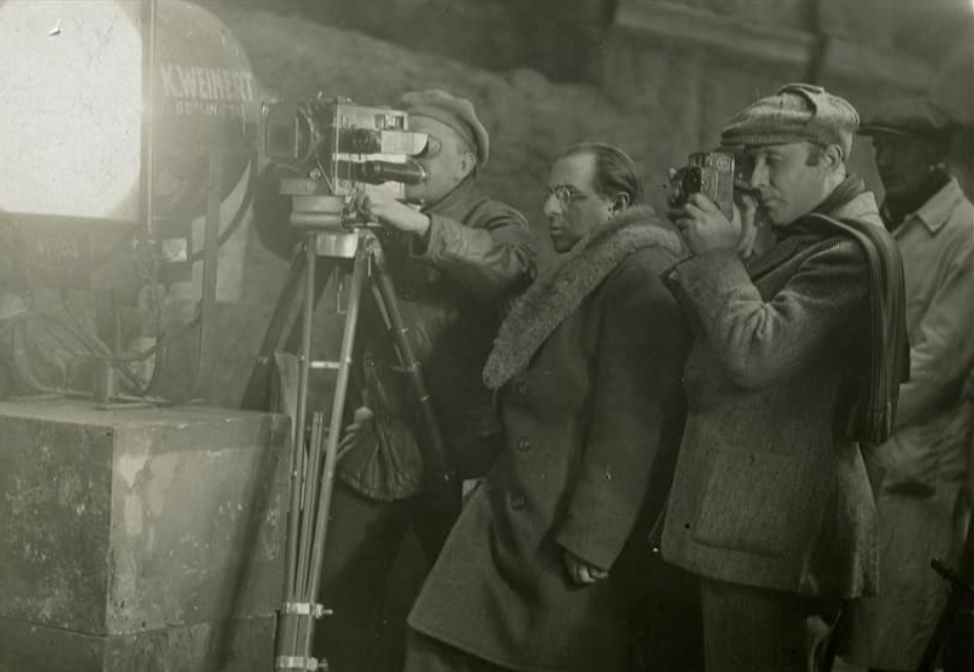
G. W. Pabst (center) during filming, Guido Seeber behind the camera.
Contemporary reports describe the studio shoot without noting any particular incidents. Later recollections by participants—where recorded in writing—tend to focus on stories about Greta Garbo, each claiming to have been the first to recognize her star potential. More credible, since confirmed by multiple sources, are the anecdotes that Pabst barred Mauritz Stiller from the set because he attempted to direct his protégée Garbo, and that cinematographer Guido Seeber countered Garbo’s visible nervous trembling by using slight slow-motion shots. This new method of “Greta Garbo photography” set a precedent: her first American films were shot entirely in this manner.32 The occasionally repeated claim that Asta Nielsen and Greta Garbo never appeared together in a scene can easily be disproved. In Act I, they stand next to each other in the queue outside the butcher’s shop; at the beginning of Act IV, both are visible simultaneously in Mrs.
Greifer’s fashion salon—though they do not interact. After 38 days of shooting, filming concluded on April 3, 1925, with what is in fact the film’s final scene: the fire in the attic and the rescue of the child.33
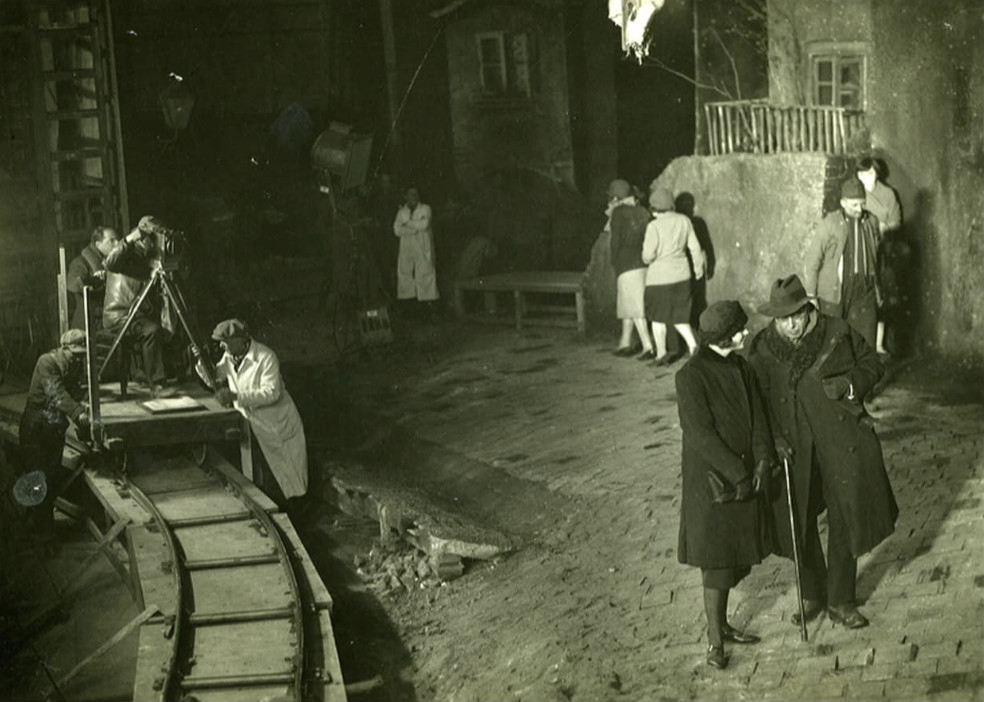
Filming in the Melchiorgasse sets at the Staaken studio.
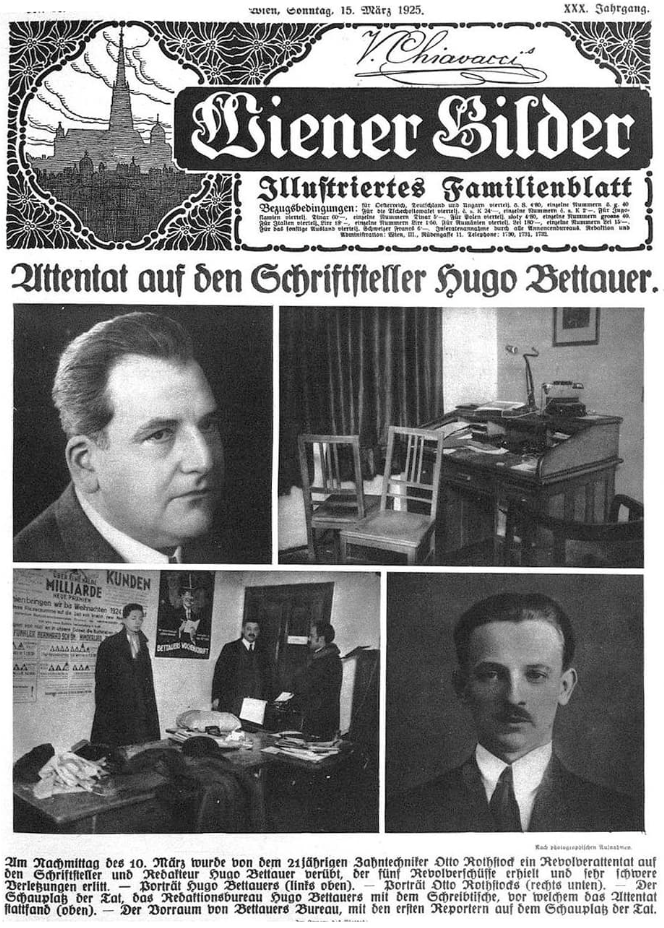
The shooting was overshadowed by the murder of Hugo Bettauer, who was shot by a fanatic in his Vienna editorial office on March 10, 1925, and died of his injuries on March 26. The contemporary press reported:
Bettauer was to appear in the film in order to lend greater definition to the figures and milieu he had sketched. Here Bettauer, as an actor, was to play the very role he otherwise portrayed in his novels as a writer. Unfortunately, his tragic death deprived him of these new and artistically interesting possibilities.34
In fact, Willy Haas’s screenplay includes an appearance by Hugo Bettauer in the long dining-room scene at the Hotel Carlton, at the table of Canez, Rosenow, his wife, and his daughter Regina:
A young, very broad and elegant gentleman with Neronian features has spotted them, rises from his table, greets Regina and her parents. Herr Rosenow introduces the man to Canez: “Herr Hugo Bettauer, the famous chronicler of Viennese misery…” Herr Bettauer bows to Regina to invite her to dance. They dance away. Rosenow remarks approvingly to Canez: “He’s made quite a handsome fortune with his books as well…”35
The scene remains in the film, but the character is now an anonymous young man who invites Regina to dance and is not further identified. Pabst had invited Bettauer to Berlin to take part in the shooting, but Bettauer—busy with his weekly magazine—had offered to come to Berlin for no more than eight days in January 1925.36
The film’s premiere, originally scheduled for April 27, 1925, had to be postponed by three weeks because completion was delayed.37 Sorkin later recalled: “We worked day and night to cut the picture, because we had no money; we had to deliver it.”38 The premiere finally took place on May 18, 1925, at the Mozartsaal cinema in Berlin. Three days earlier, the film had been approved by the censorship board with only minor cuts and a ban for young audiences. The film ran for sixteen days,39 with two screenings daily at 7:00 p.m. and 9:15 p.m., and a third screening on Sundays at 4:45 p.m.
The cinema itself was specially decorated: the audience entering the building first had to pass through a constructed “Joyless Street” in the foyer before purchasing tickets at the Mozartsaal box office. Pale light shone from individual windows of this impoverished Viennese quarter onto the brightly illuminated staircase of the Mozartsaal. The set functioned as an atmospheric device, preparing the audience for the coming events, making them more receptive, and thereby contributing to the film’s success.40
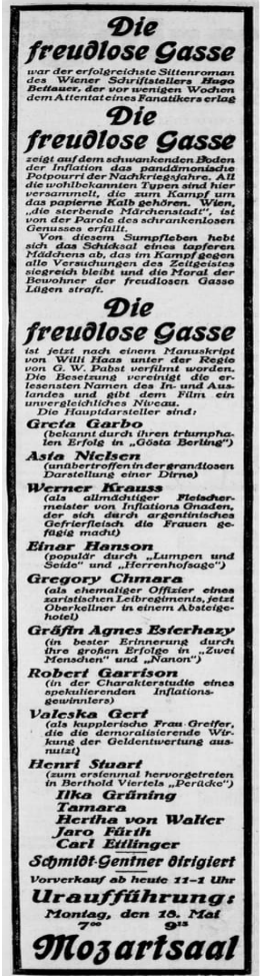
Berliner Tageblatt, May 17, 1925
Reviews reported sustained applause at the premiere and praised above all the direction and performances:
For a tiny scrap of meat, for the most primitive necessities, but also for trivial vanities and greedy speculation, women and girls sell themselves; men sacrifice position and honor. The dollar poisons old and young alike, allows profiteers to revel in the vilest nightclubs and nude cabarets, while the working population starves and degenerates! — Willi Haas has masterfully transformed Bettauer’s novel into a truly living image on screen; G.W. Pabst has breathed creative, passionate life into his words. And a host of great artists, in intimate and selfless collaboration, have given these characters heart and soul. Not one fell outside the precious frame; it almost seems unjust to single out a few names: Asta Nielsen, Greta Garbo, Tamara, Countess Esterhazy, Hertha von Walther, Valeska Gert, Werner Krauss, Jaro Fürth, Robert Garrison, and—though only in an episode and yet unforgettable—Grigorij Chmara! An ensemble rarely equaled. Added to this, Seeber’s atmospheric cinematography and the often uncannily authentic sets by Söhnle and Erdmann— in short: this magnificent work, this “Joyless Street,” will surely leave nowhere a “Joyless Box Office.”41
After its run at the Mozartsaal, The Joyless Street remained in Berlin cinemas for four additional weeks.42 In Munich, the film played for sixteen days beginning July 22, 1925, at the Regina Theater. At the end of September 1925, Der Kinematograph reported that more than forty prints were in circulation in Germany.43
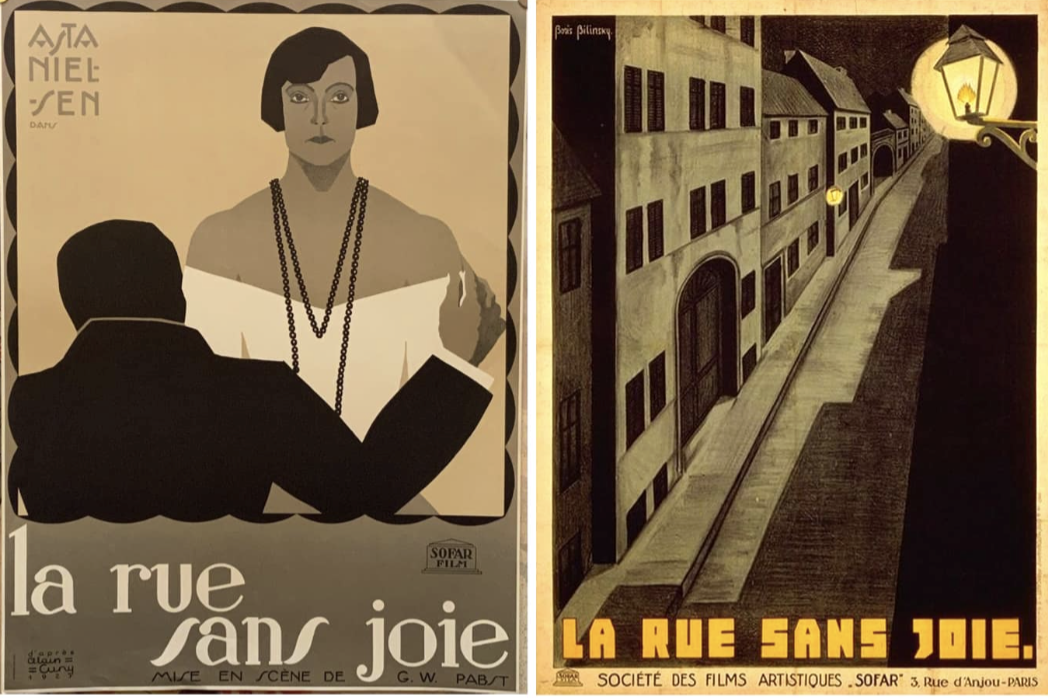
Already during production, Sofar-Film-Produktion GmbH attempted to sell The Joyless Street worldwide. The Austrian company Sascha-Film announced its acquisition of the film as early as April 4, 192544; the French Sofar promoted the film in a magazine dated May 9, 1925.45 On March 1, Der Kinematograph reported negotiations between the German Sofar and the American United Artists Association.46
Salkind was more interested in film trade and export business across national borders than in further film production. By July 1925, Film-Kurier announced a restructuring of Sofar: “Salkind moving into Sofar distribution.”47 Together with Hans Hirschel—whose company J&M Hirschel distributed The Joyless Street in northern, central, and southern Germany as well as in the Rhineland-Westphalia region—Salkind founded Hisa-Vertriebs GmbH and Hirschel-Sofar-Verleih on July 30, 1925.48
Salkind left Sofar-Film-Produktion GmbH to Pabst, who renamed it Pabst-Film GmbH.49 In 1929, Pabst used the company to produce Diary of a Lost Girl. In November 1925, French Sofar advertised that only the distribution rights for Belgium, Spain, Great Britain, and America remained available.50 However, it primarily established itself as a distributor of foreign films and, after The Joyless Street, imported German silent classics such as The Adventures of Prince Achmed, Berlin: Symphony of a Great City, and Pabst’s Abwege.
The success of The Joyless Street proved unusually long-lasting—due not least to Greta Garbo’s rapid rise to Hollywood stardom.51 In Munich, after its initial run, the film was shown in at least five additional theaters through December 1925, always with extended engagements because of its popularity,52 and it enjoyed several successful revivals through the end of the silent era.53 Characteristic is an advertisement by “Zach’s Rumford-Lichtspiele,” which appended to the film title only the words “Advertising unnecessary.”54In Paris, La Rue sans joie was repeatedly screened in repertory cinemas, often for weeks at a time, until the original film was replaced in 1938 by a sound-film remake of the same title.55
The film’s success was also fueled by press reports accusing it of inferiority and calling for its prohibition. The Prague-based central organ of the Social Democratic Workers’ Party in Czechoslovakia, Sozialdemokrat, judged: “The film adaptation of the kitschy, literarily worthless novel by the writer Hugo Bettauer, murdered in Vienna last year, is as shallow and inferior as its source. (…) Even the well-known leading actors are unable to shed light on the unclear and at times incomprehensible proceedings.”56 Dr. Schorn of the “Bonn Working Group for the Preservation of Decency and Morality” rejected the film outright: “Its essential aim is only too clear: the incitement of the basest sensuality. What purpose does the procuress Greifer serve, at whose house orgies of the most sordid kind take place? If the film felt it could not omit the nightlife of the imperial capital when depicting culturally destructive conditions, it would have sufficed to sketch it briefly.”57
Indeed, although the film was sold worldwide, it was banned in countries such as Romania58 and temporarily in Japan.59 All surviving contemporary prints of The Joyless Street are shortened and reworked versions. These alterations were not due solely to censorship interventions but also to efforts to simplify the complex structure of the social panorama and to concentrate on fewer characters.
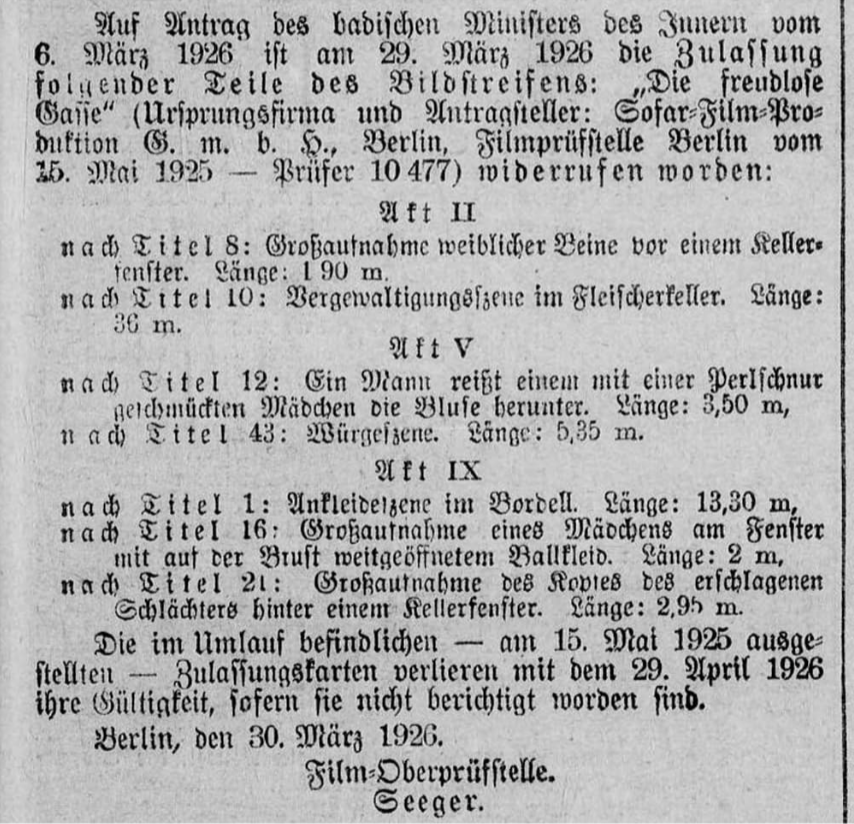
Deutscher Reichsanzeiger, 31.3.1926
Even at its German premiere, The Joyless Street was no longer complete. Three days earlier, on May 15, 1925, the 3,738-meter film had been submitted to the censors and, after a cut of 3.55 meters, was approved—though banned for youth audiences. What exactly was removed is unknown; only the approved censorship length is documented: 9 acts, 3,734.45 meters. If screened at what is today considered a realistic projection speed of 19 frames per second, the film would run 173 minutes60. Yet at the Berlin premiere theater, the Mozartsaal, screenings began every 135 minutes—this would imply a projection speed of 27 frames per second. When The Joyless Street was submitted on March 29, 1926, to the Higher Review Board—after the government of Baden had requested revocation of the film’s license on the grounds of immoral and brutalizing tendencies—the presiding official observed with surprise that the print screened at the beginning of the proceedings in the presence of G.W. Pabst measured only 3,542 meters instead of the 3,738 meters listed on the approval card of May 15, 1925, and that it contained a different division into acts than both the print originally submitted and the approval documentation.61 It is possible that this version had already been shown at the premiere.62
Time pressure, alongside inflated production costs, likely explains why the premiere—announced in trade papers as a major social event63—proved relatively modest: there were no speeches or receptions, only bows, bouquets of flowers, and applause. 64 In addition to other cast members, Agnes Eszterhazy and Greta Garbo along with G.W. Pabst, assistant director and editor Marc Sorkin, screenwriter Willy Haas, Michael Salkind, and Moïse Zlatopolsky65 attended the premiere and a subsequent dinner at a Russian restaurant that had extended credit to the financially strained production company.66
Abroad, The Joyless Street was shown only in even shorter versions. In Stockholm, where Den glädjelösa gatan opened on September 28, 1925, in two cinemas, the official approved length was 8 acts and 2,788 meters.67 In a contemporary letter from the distributor to the censorship authority, a length of approximately 1,900 meters was even stated.68 In Vienna, the film opened on November 6, 1925, in six cinemas. In Bettauer’s Weekly, Pabst complained that in Austria his film had been mutilated to the point of incoherence, with nearly half of it cut.69
In Paris, the heavily promoted premiere of La Rue sans joie took place on November 10 at the Empire cinema and was attended by numerous prominent figures from politics, business, and culture, including directors Abel Gance, Jacques Baroncelli, Raymond Bernard, Alexandre Wolkoff, and Alberto Cavalcanti. The film was accompanied by a large orchestra and, at moments, by “fantastical arabesques of Negro jazz.” 70 Applause during scenes drowned out isolated anti-German boos.71 The film entered regular release on January 21, 1926, at the newly opened Paris art cinema Studio des Ursulines, with an exquisite accompanying program: a 20-minute compilation of early film history and the Dadaist avant-garde classic Entr’acte by René Clair. The Joyless Street remained in the cinema’s daily program for ten weeks, until April 1.72 La Cinématographie Française listed the film’s length as 2,600 meters.73
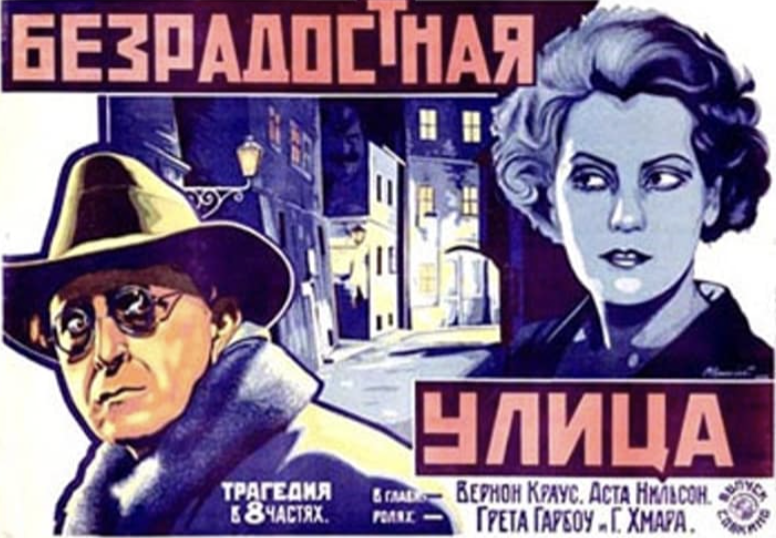
In Leningrad, Bezradostnaya ulitsa is screened for three weeks beginning January 12, 1926, accompanied by a large orchestra. A reviewer in The Worker and the Theater noted: “In a completely incomprehensible manner, an entire series of shots—perfectly acceptable under the conditions of our society—fell victim to the scissors of the Soviet editor. The harmonious flow of the plot is disrupted without any justification perhaps only to justify the signature on the exhibited copy: editor-montage Vasilyev.”74 In Moscow, the film ran for one week beginning April 13 in two cinemas.75
Kenneth McPherson ironically described the fate of The Joyless Street:
When completed it was ten thousand feet in length, roughly the same as Ben Hur or The Big Parade. France, on accepting it belatedly, promptly slashed out a couple of thousand feet as well as every single “shot” of the street itself. Since then bits have been added and bits taken away. Vienna, for no discoverable reason, extracted all the Werner Krauss sequences, so that he did not appear in
the film at all. Russia found it necessary to turn the American lieutenant into a doctor and turned Krauss into the murderer instead of the girl. (…) In England at the Film Society it hung together in shreds.76
Screenwriter Willy Haas complained in 1928:
The real hero of this film is an inflation-era butcher who officially “has no meat,” yet supplies as much as one wants through the back door—especially to young women and girls who return the favor. In this way he prostitutes an entire street. That this and worse occurred during the inflation can be proven by hundreds of newspaper reports. No German censor would have dared, shortly after the inflation, to lie away such undeniable truths. Today, three years later, they have finally found the courage for hypocritical suppression. The central scene has been cut: a young girl overhears the price her friend must pay in the next room to obtain meat. I showed none of this explicitly at the time—only the horrified face of the young girl listening, a mimed monologue brilliantly performed by the great Asta Nielsen. But the censors cut it out—now, after three years. The butcher now gives meat to young girls for incomprehensible reasons, presumably out of generosity. The film is ruined.77
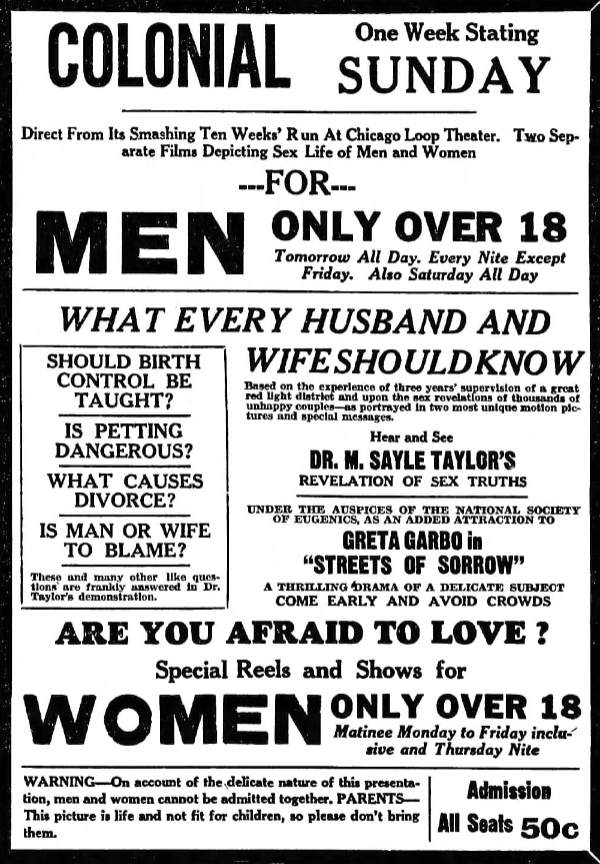
Decatur Herald, January 28, 1928
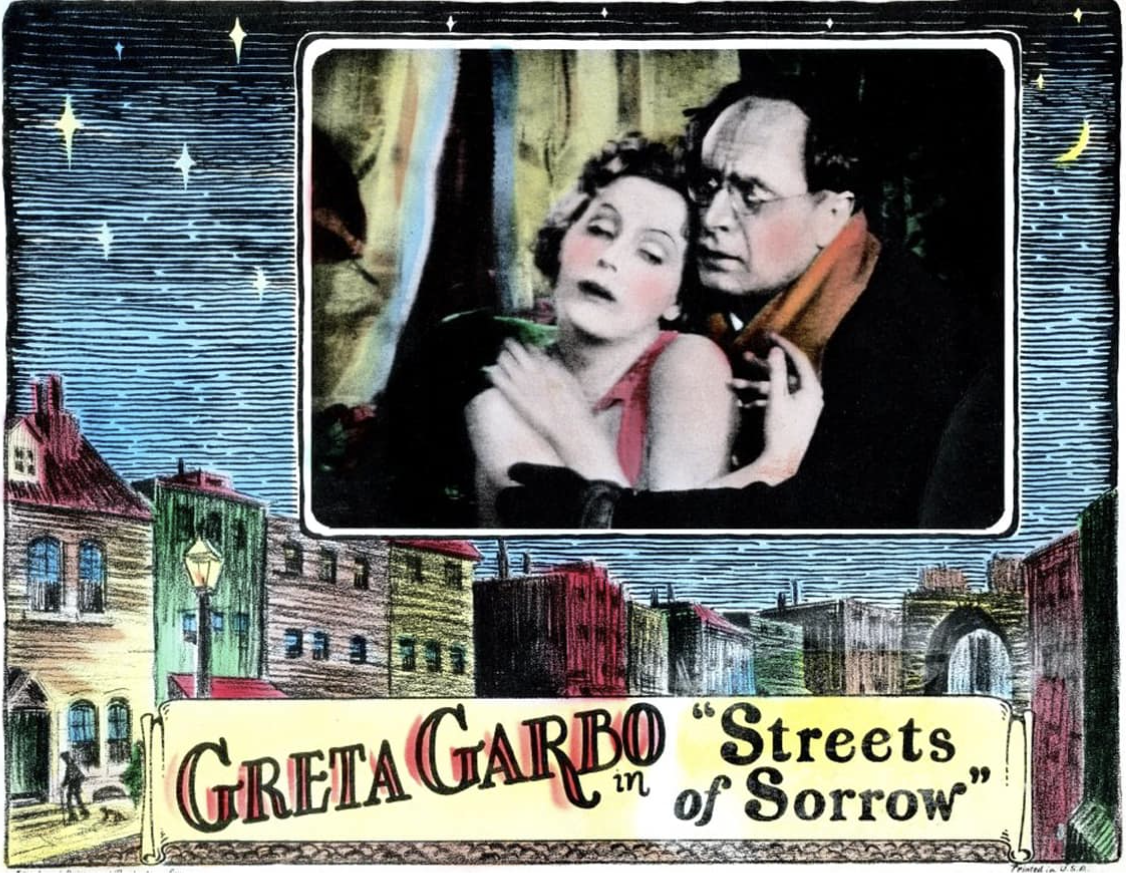
The handling of the film in the United States is particularly noteworthy. When it opened in New York on July 2, 1927, under the title Streets of Sorrow, it reportedly ran approximately 9,000 feet (around 2,700 meters) and received mocking reviews. On the “Woman’s Page” in Variety, Molly Gray warned:
Streets of Sorrow is recommended to people with failing memories, as a test. If they can follow and keep track of all the people in this and have any idea which was who and what was when, after it’s over, they can pat themselves on the back and discontinue the memory course. There’s no doubt there were many tragedies in Vienna after the war and this is one of them. (…) If Greta Garbo is a star today, she can thank Hollywood.78
Film Daily described the film as “an almost incoherent and incomprehensive series of scenes which give but the vaguest ideas of what it is all about.”79 Subsequently the film fell into the hands of dubious distributors who further cut and altered it. In a December 1, 1937 article, Variety summarized the film’s American fate:
By the time the film got over here in 1926–27, it had been recut to make Garbo the lead, with Nielsen practically eliminated. At that time, the film, which had heavy sex angles due to depressed conditions of post-war Vienna which it depicted, had been arranged with subtitles as an “exposé of prostitution,” and was shown in Midwestern houses on alternate days for men and women only, with sex talks by Dr. M. Sayle Taylor, since become famous as “Voice of Experience” on the airways. Recently reissued by an indie outfit, the film is currently showing at Criterion, Los Angeles, a bootleg house featuring the indie Children of Loneliness, a film on lesbianism. Streets of Sorrow runs to four reels, with dialogue and commentary dubbed in. Not only does the commentator poke copious fun at the film, but actors are made to speak in various dialects, foreign accents, and humorous voices.80
Over the years, lawsuits were conducted concerning the American distribution rights to The Joyless Street, which ultimately denied Sofar any remaining claims.81
In 1963, Romain Pines sent Rudolph S. Joseph, director of the Munich Filmmuseum, a short text for a publication accompanying an exhibition on G.W. Pabst:
In 1924 I met G.W. Pabst. At that time his world-famous film The Joyless Street was created, a work that sparked a revolution in the art of cinema. In the years that followed until World War II, Pabst and I collaborated frequently, producing among others Atlantis, Drame de Shanghai, and Mademoiselle Docteur. My collaboration with G.W. Pabst remains indelibly etched in my memory. Quite apart from my warm sympathy and admiration for him as a person, I felt the greatest admiration for his creative power, his wealth of ideas, and his profound honesty of vision, which were unparalleled.82
He does not claim to have produced The Joyless Street, since he merely imported it to France as distributor, marking his entry into the film business.83 Beginning in 1927, Pines attempted to produce French films alongside Sofar’s distribution activities, increasingly shifting production to newly founded companies. Sofar ceased operations in the early 1930s and was officially dissolved in 1936. The liquidator, Alexandre Lefèvre, noted on March 25, 1936:
The films owned by the company have no value, as they are silent films for which no market can be found. Furthermore, they are all pledged as security to the company Sofici for advances granted to Sofar.
Sofici had already been liquidated in 1932.
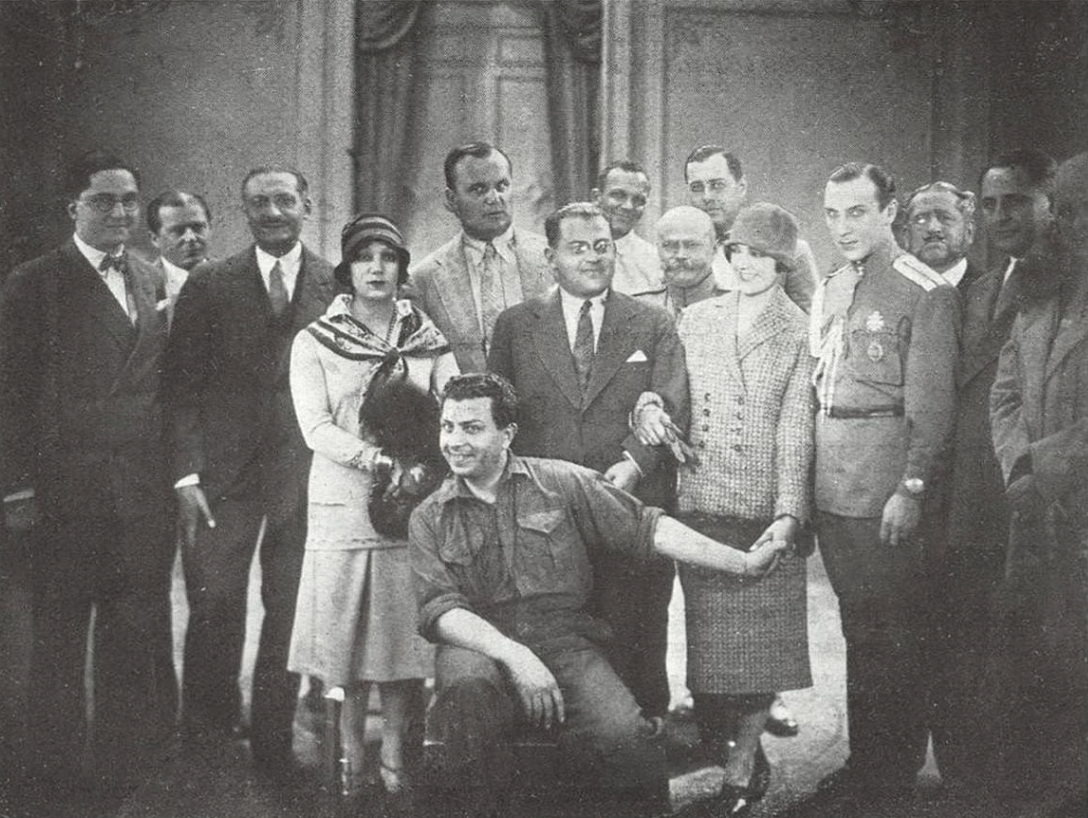
Romain Pines (standing center) with the crew of The Secret Courier (1928).
In a February 1967 radio interview, Pines reported on Pabst’s serious illness and claimed to be in correspondence with him. 84 In September 1967, weeks after Pabst’s death on May 29, Pines obtained confirmation from the Cinémathèque française that his name appeared in the credits of an English-language print of The Joyless Street as co-producer. 85 That Pabst was named as principal producer and director, and that the English-language print bore little resemblance to the original version of the film and had little evidentiary value, didn’t matter. As a Jewish émigré, Pines apparently needed no documentation; notarized statements from himself and Salkind sufficed for him to be registered as rights holder.
Salkind certified to his friend and business partner Pines:
I, the undersigned Michel Salkind, hereby attest that the film La Rue sans joie, directed by G.W. Pabst, was produced in 1925 on behalf of the Société des Films Artistiques SOFAR by Sofar-Productions (Berlin), of which I was one of the administrators. This latter company was created by the former solely for the purposes of producing this film. The film was therefore from the outset the property of Films Artistiques Sofar.86
Pines justified his claim—despite the broken chain of rights following Sofar Paris’s dissolution—by asserting an undocumented transfer of rights from Sofar Paris to him personally and declared himself sole and exclusive owner of The Joyless Street. When selling unlimited worldwide rights to “Connaissance du Cinéma” on December 15, 1967, Pines prudently excluded West and East Germany, Austria, and Switzerland, presumably to avoid confrontation with Pabst’s heirs.
In 1981, Catherine Gaborit of “Connaissance du Cinéma” released a reconstruction with new musical accompaniment. Francis Courtade sharply criticized this version:
The French reissue of 1981 is another kind of massacre. Not only are the images—unstable, of uneven and often poor quality—so clumsily edited that one sometimes has the impression of attending a festival of splices, but the sound accompaniment is an outrage to decency. Following the execrable system adopted for many American burlesques and some Chaplin films, two or three inane musical themes are endlessly repeated.87
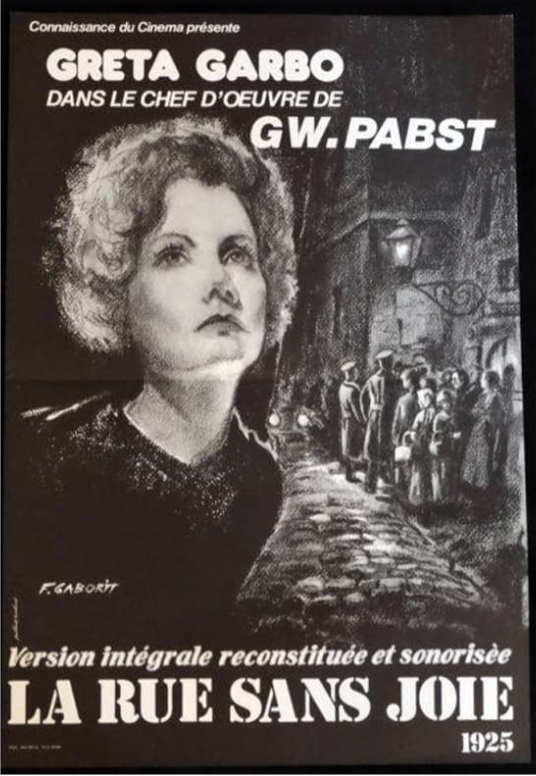
In 1983, Alexander Salkind stated in an interview about the films produced by his father Michael and himself: “We still own all our movies. And right now I’m negotiating video outlets with different countries for films like Joyless Street, Austerlitz, and The Trial.”88 A few years later, “Connaissance du Cinéma” sold its purported rights to the French company “Roissy Films”, which was acquired in 2008 by Luc Besson’s “EuropaCorp.” In 2018, “EuropaCorp.” transferred the films acquired from Pines to “Cité Films,” a company founded in 1997 by the former CEO of “Roissy Films.”
In 1979, Enno Patalas unsuccessfully attempted to acquire a 35mm print from “Connaissance du Cinéma” for the Munich Filmmuseum.89 In 1988 he contacted Gosfilmofond:
If I’m informed correctly, you have a print of the old Russian version. I once have been told that your material is not in good condition, but then I heard that the GDR television has shown a version mainly based on your material – so it can’t be too bad. As there is no complete, authentic and visually satisfying print known to me, I guess it would be interesting for us to try to restore this film.90
Gosfilmofond answered positively:
We shall make a new print of DIE FREUDLOSE GASSE in our laboratory and send it to you as a permanent loan on the exchange basis. We shall try to make the print of maximum possible good quality which would fit your project of restoration the film.91
In exchange Gosfilmofond requested
videocassettes of films made in the last 10-15 years in any country in the world, the subject of which is directly or in at least some degree connected with our country. These materials are of great need of our research now.”92
The Russian print, at 2,950 meters, was also substantially shorter than the premiere version and included at least 100 meters of foreign footage,93 but it contained approximately 500 meters missing from all other materials. For other parts, Patalas relied on a 2,309-meter French print from the Cinémathèque française and a 2,168-meter English print from the British Film Institute’s National Film and Television Archive.
All three prints differed in scene order and editing. The original screenplay by Willy Haas (held by the Munich Filmmuseum) and Marc Sorkin’s working script (held by the Museum of Modern Art in New York) proved only partially helpful, as many scenes—especially in the final third—had been cut, condensed, or rearranged during shooting. According to Michael Pabst, his father did not strictly follow the script once on set; the real screenplay existed in his head.94
Based on the screenplay and a censorship file from the Berlin Higher Review Board, Patalas created new German intertitles. His attempt to involve the German Federal Archives as a partner in producing a negative of the reconstructed version was unsuccessful.95 The reconstruction premiered on October 9, 1991, at the first “CinéMémoire” festival of the Cinémathèque française at the Théâtre national de la Colline, accompanied on piano by Jean-Marie Senia.
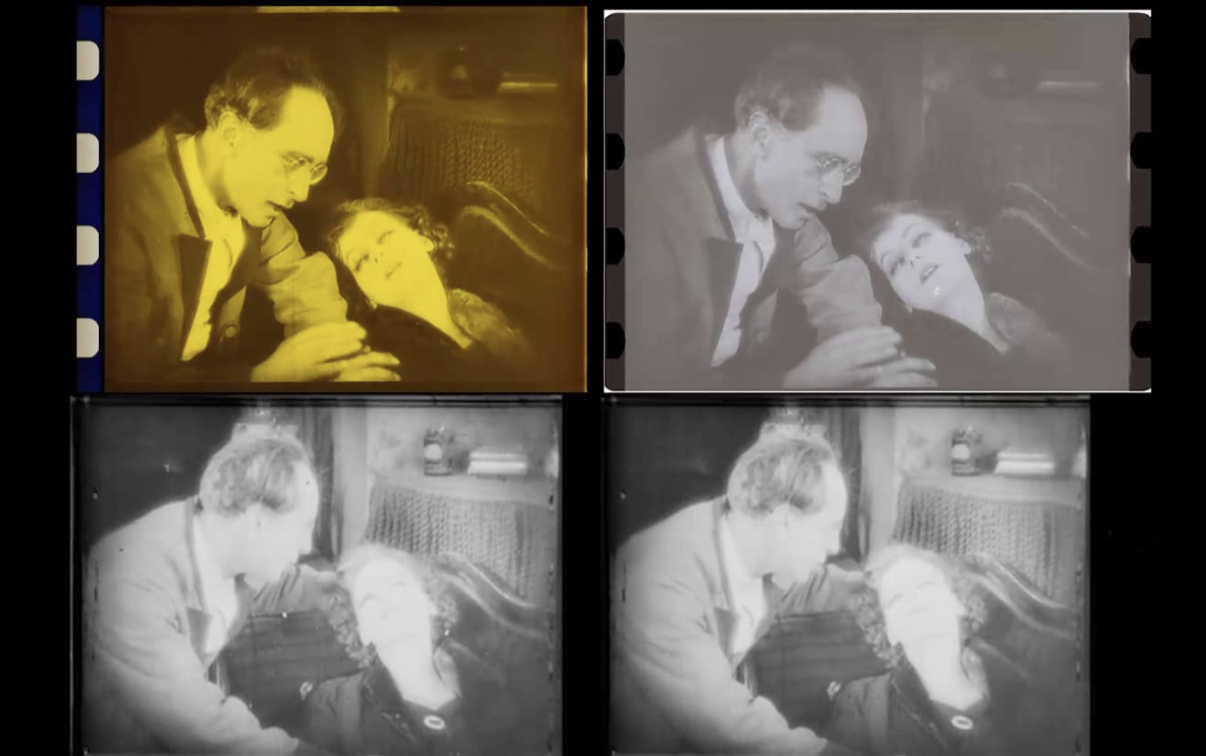
Above: B-Negative digital scan. Below: the same scene in the A-Negative, analogue dupe.
Jan-Christopher Horak, who who took over the management of the Munich Filmmuseum in 1994, continued the reconstruction of The Joyless Street with support from the European Lumière Project. The result was a negative of the reconstructed version, produced at the laboratory “L’Immagine Ritrovata” in Bologna. As source materials, original nitrate prints from the Library of Congress, the George Eastman House, the Cineteca Italiana in Milan, and the Cinémathèque française were incorporated, along with two small reels of outtakes from the collection of the Deutsche Kinemathek.96 Since three of the materials were consistently tinted—though the choice and transitions of the partially faded and time-altered colors differed considerably—a concept was developed for tinting the reconstructed version using the Desmet method.
In determining the wording of the intertitles, priority was now given to back-translations from the surviving film prints rather than to the formulations in the screenplay. At least two different camera negatives could be identified: the materials from Moscow and Rochester, along with part of the Milan print, derived from one negative; the materials from Paris and London, along with the remaining parts of the Milan print, derived from another negative with perspectivally altered shots.97 To restore as complete a version of the film as possible, material from both negatives had to be used. Avoiding to disrupt the very precise continuity of Pabst’s editing patterns, efforts were made within individual sequences to rely largely on shots from a single negative. A first color print, prepared by Nicolai Mazzanti, premiered in June 1997 at the festival “Il Cinema Ritrovato” in Bologna.
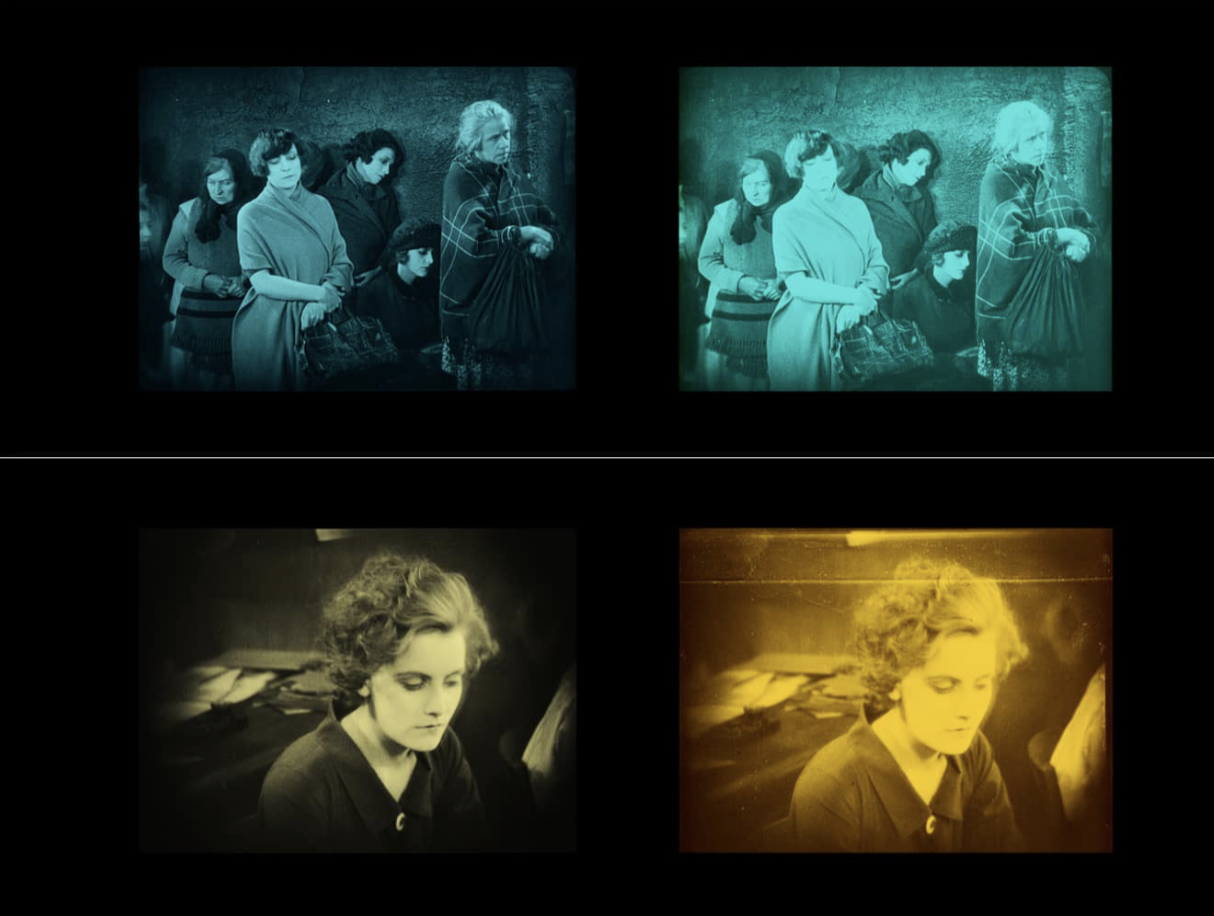
Left: Digital scan and digital tinting. Right: Analog color print using the Desmet color process.
For the production of a DVD in the Edition Filmmuseum series, the film was revised again in 2009 under the direction of Stefan Drössler who became head of Munich Filmmuseum in 1999. The wording, number, and placement of the German intertitles were reviewed and corrected once more, drawing on censorship files and a contemporary program booklet, which were compared with the screenplay. Some editing sequences were also altered. The “happy ending” scene described in the screenplay, which in the second reconstruction had been inserted rather arbitrarily in the middle of Act 9, was moved back to its position preceding the final scene with the burning house.98
The creation of a digital master for the 100th anniversary of the premiere in 2025 finally offered the opportunity to optimize exposure values and grading frame by frame. Besides, a more differentiated concept for tinting the scenes was developed. Compared to the analog 35mm color prints produced using the Desmet method, image quality was significantly improved. The stark differences among the various source materials were minimized through extensive digital retouching, and many shots in which individual frames had been lost during analog printing transitions were completed. The intertitles were revised once again and newly typeset in a font closely approximating one of the original typefaces. This work was made possible by generous support from the “Sunrise Foundation for Education and the Arts.” On August 26, 2025, the new version premiered at a sold-out screening at the Munich Filmmuseum and was presented with a newly revised live musical accompaniment by Sabrina Zimmermann and Mark Pogolski, receiving standing ovations.
Of the film’s original length, just under 500 meters—approximately twenty minutes—remain missing. Much of this difference may be attributable not to missing scenes but to substantially longer intertitles, necessary to ensure readability at the elevated projection speeds used in premiere cinemas. However, as long as no additional documentation of the original version emerges—such as the German censorship card containing the original intertitle texts or film materials of previously unknown scenes—the new version can only represent the best possible approximation of the film’s original form. More precisely, one might speak of an interpretation of the film by its responsible editors—inevitably shaped by numerous subjective decisions—and for that very reason unlikely to be the final attempt at reconstructing the original version of The Joyless Street.
With thanks to
Thomas Bakels, Marie Bendl, Axel Block, Camille Blot-Wellens, David Drevs, Oliver Hanley, Jan-Christopher Horak, Marion Jaros, Christian Ketels, Ernst Kieninger, Andrea Kirchhartz, Armin Loacker, Enno Patalas (†), Ellen Schafer, Werner Sudendorf, Gerhard Ullmann, Klaus Volkmer, Cynthia Walk, Stefan Wimmer, Wolfgang Woehl, Elzbieta Ewa Wysocka.
Stefan Drössler, film historian, lecturer and curator, has been Director of Bonn International Silent Film Festival (1985-2020), Bonner Kinemathek (1986-1999), and Filmmuseum Muenchen (since 1999). He reconstructed and restored more than 150 films and edited more than 100 DVDs in the Edition Filmmuseum (www.edition-filmmuseum.com).
The best version of JOYLESS STREET currently on DVD is the 2009 restoration. It is still available here, with English subtitles and a lot of bonus material, including a documentary about G.W. Pabst by Hannah Heer and Werner Schmiedel.
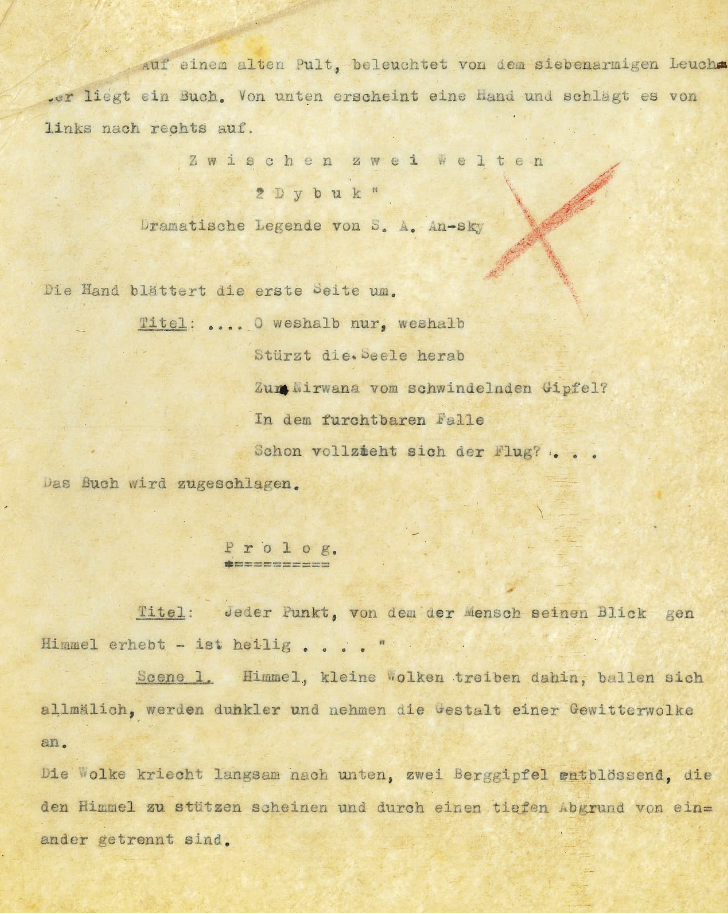
G.W. Pabst’s unfilmed screenplay of Dybuk by Salomon An-sky
Footnotes
1 “Old Garbo German Pic Is Claimed by Brandon”; Variety, 25.1.1961. pp. 3, 63
2 Alexander Salkind about his father Michael: “When the Russian Revolution comes, he’s stripped of his possessions and barred from practice by the Bolsheviks. They take everything they set eyes on! Luckily, they don’t set eyes on the family gems my father hides in his suit. When my parents flee Minsk they have to stop in Danzig, because my mother was in labor, and that is the beginning of me. My father’s six months at the Leningrad Opera – that was his baptism into dealing with creative people. Then we flee to Berlin with many other White Russian emigrés. It was a time of upheaval you couldn’t believe. In Berlin my father isn’t able to continue his law practice, because under German law at that time he would have had to apprentice himself again for five years.” (Harlan Kennedy: “Super Salkinds”; Film Comment No. 3, New York Mai-Juni 1983, p. 50)
3 Commercial Register entry No. 25913; Deutscher Reichsanzeiger, Sept. 29, 1922.
4 “The establishment, direct or indirect operation of commercial and industrial cinematographic enterprises; the production, sale, commission, export, and import of cinematographic films; the establishment, purchase, direct or indirect operation, and sale of cinemas and film exhibitions; the allocation, with or without profit participation, of cinematographic films; and in general all movable, immovable, and mixed industrial, commercial, or financial enterprises or operations directly or indirectly related to the corporate purpose.” (Statuts de la société anonyme, Paris, Dec. 9, 1924, pp. 1–2.)
5 This previously unidentified individual has given rise to much speculation: Hans-Michael Bock claims it was Salkind; Sarah Hall even suggests Romain Pines. (Hans-Michael Bock_:_ “Biography”; in Wolfgang Jacobsen [ed.]: G.W. Pabst; Argon Verlag, Berlin 1997, pp. 254–256 / Sarah F. Hall: “Inflation and Devaluation”; in Noah Isenberg [ed.]: Weimar Cinema; Columbia University Press 2008, p. 137.)
6 Association pour la Sauvegarde de la Sucrerie de Francières, La Sucrerie de Monchy-Humières; Francières 1996–2019.
7 Gero Gandert: Interview mit Marc Sorkin; Deutsche Kinemathek, Berlin, October 1978.
8 Izaly Zemtsovsky: “The Musical Strands of An-sky’s Texts and Contexts”; in Gabriella Safran and Steven J. Zipperstein (eds.): The Worlds of S. An-sky; Stanford University Press 2006, p. 206.
9 Various versions of Pabst’s original screenplay are preserved by Filmmuseum München.
10 Advertisement in Österreichische Buchhändler-Correspondenz, Vienna, Jan. 4, 1924, p. 11.
11 “Die freudlose Gasse_”_; Der Tag, Vienna, Jan. 27, 1927.
12 “Die freudlose Gasse”; Tages-Post, Linz, Mar. 2, 1924, p. 22 / Heinz Michaelis: “Die freudlose Gasse”; Film-Kurier No. 117, May 19, 1925 / “Filmbesprechungen”; Neue Freie Presse No. 21971, Nov. 18, 1925, p. 8.
13 Advertisement in Der Filmbote No. 23, Vienna, June 7, 1924, p. 4.
14 “Der neue J. N. Ermolieff-Film ‘Die Mausefalle’”; Der Filmbote No. 23, Vienna, June 7, 1924, p. 16.
15 Letter from Hugo Bettauer to G.W. Pabst; Vienna 17.10.1924
16 Gero Gandert: Interview mit Marc Sorkin; Deutsche Kinemathek, Berlin October 1978.
17 In the 1960s, Pabst sold the 332-page handwritten screenplay by Willy Haas together with other screenplays (including drafts for the unrealized film Dybuk) to the Filmmuseum München.
18 Willy Haas: Die literarische Welt; Paul List Verlag, Munich 1957, p. 88
19 Michael Pabst: “Die freudlose Gasse“; in Wolfgang Jacobsen (ed.); G.W. Pabst; Argon Verlag, Berlin 1997, p. 143-148.
20 Letter from Michael Salkind and G.W. Pabst to Greta Garbo, Berlin January 26, 1925
21 Michael Pabst: “Die freudlose Gasse“; in Wolfgang Jacobsen (ed.): G.W. Pabst; Argon Verlag, Berlin 1997, p. 139.
22 Alfred Rosenthal: “Kritisches Notizbuch“; Berliner Lokal-Anzeiger, May 25, 1925.
23 Gideon Bachmann (ed.): “Six Talks on G.W. Pabst“; Cinemages 3, Group for Film Study, New York 1955, pp. 26 and 40.
24 Michael Pabst: “Die freudlose Gase“; in Wolfgang Jacobsen (ed.): G.W. Pabst; Argon Verlag, Berlin 1997, p. 143-144. The scenes featuring the named persons have not been identified. They either belong to now-lost footage or were cut during editing.
25 Maria Wirth: Christian Broda; Vienna University Press, Vienna 2011, p. 46.
26 “Personalien”; Der Film No. 11, Berlin, Mar. 15, 1925, p. 38.
27 Advertisements in Kinematograph No. 939, Düsseldorf, Feb. 15, 1925; in Der Film No. 7, Feb. 15, 1925; and in Lichtbild-Bühne No. 8, Berlin, Feb. 21, 1925.
28 “Wiener Brief”; Film-Kurier No. 48, Feb. 25, 1925, p. 1.
29 “Aus der Werkstatt”; Der Kinematograph No. 944, Mar. 22, 1925, p. 27.
30 Fred Olimsky: “Eine Modenschau im Zoo-Atelier”; Berliner Börsen-Zeitung No. 125, Mar. 15, 1925, p. 7.
31 “Schwedische Schauspieler beim Sofar-Film_”_; Süddeutsche Filmzeitung No. 11, Mar. 13, 1925, p. 8.
32 Michael Pabst: “Die freudlose Gasse”; in Wolfgang Jacobsen (ed.): G.W. Pabst; Argon Verlag 1997, p. 148.
33 Sorkin’s notes in his working screenplay
34 “Bettauer and His Film”; Neues 8 Uhr-Blatt, Apr. 20, 1925, p. 8.
35 Willy Haas: Die freudlose Gasse; Berlin 1925, p. 44. (image 20)
36 Letter from Hugo Bettauer to G.W. Pabst; Vienna, Jan. 2, 1925.
37 Advertisement in Die Filmwoche No. 16, Berlin, Apr. 15, 1925, p. 384.
38 Gideon Bachmann (ed.): “Six Talks on G.W. Pabst”; Cinemages 3, Group for Film Study, New York 1955, p. 29.
39 Heinz Udo Brachvogel: “Der deutsche Film im deutschen Theater”; Kinematograph No. 961, Düsseldorf, July 19, 1925, p. 11.
40 “Der freudlose Fiaker”; Der Film No. 21, Berlin, May 24, 1925, pp. 26–27.
41 Dr. Mendel: “Die freudlose Gasse”; Lichtbild-Bühne No. 77, May 19, 1925.
42 Ernst Hofmann: “Lettre de Berlin”; Cinémagazine No. 42, Paris, Oct. 16, 1925, p. 118.
43 “Wovon man spricht”; Der Kinematograph No. 971, Sept. 27, 1925, p. 49.
44 Advertisement in Der Filmbote, No. 14, Apr. 4, 1925, p. 4.
45 Advertisements in Hebdo-Film No. 480, May 9, 1925, pp. 8 and 13.
46 Der Kinematograph Nr. 941, Düsseldorf 1.3.1925. S. 44
47 “Bei dem Schöpfer der ‘freudlosen Gasse’”; Film-Kurier No. 170, July 22, 1925.
48 Reichsanzeiger Nr. 250, 24.10.1925. In 1927 Hans Hirschel withdrew. From Jan. 20, 1927 onward the company continued as “Sofar Verleih GmbH,” with an increase in share capital, and was liquidated at the end of the year. Serious irregularities led to the dissolution of the firm (“Zusammenbrüche in der deutschen Filmindustrie”; Das Kino-Journal, Vienna, Oct. 5, 1929, p. 5).
49 Deutscher Reichsanzeiger No. 211, Sept. 9, 1927.
50 Advertisement in La Cinématographie française, Nov. 7, 1925.
51 In 1926 MGM released Greta Garbo’s first three Hollywood films: The Torrent (dir. Monta Bell), The Temptress (dir. Fred Niblo), and Flesh and the Devil (dir. Clarence Brown).
52 Beginning Aug. 15, 1925, the film played at “Zach’s Rumford Lichtspiele”; from Oct. 14, 1925 at the “Eden Theater”; from Oct. 20, 1925 at the “Bergpalast”; and from Nov. 14, 1925 at the “Walhalla” cinema.
53 From June 18, 1926 the film ran at the “Fern-Andra-Lichtspiele”; from Aug. 3, 1927 at the “Union-Theater”; from Aug. 17–24, 1927 and Feb. 7–12, 1929 at the “Marmor-Haus.”
54 Advertisement in Münchner Neueste Nachrichten, Aug. 15, 1925.
55 La Rue sans joie, France 1938, directed by André Hugon, with Dita Parlo, Albert Préjean, Marguerite Deval, Pierre Alcover.
56 “Die freudlose Gasse”; Sozialdemokrat No. 7, Prague, Jan. 8, 1926, p. 6.
57 “Bonner Nachrichten“; Deutsche Reichs-Zeitung, Oct. 21, 1925.
58 “Censure Roumaine”; La Cinématographie française, June 9, 1928, p. 5.
59 “La Rue sans joie … au Japon”; La Cinématographie française, July 21, 1928, p. 8.
60 The rental list of “Welt-Film G.m.b.H.” enclosed with Film und Volk No. 11/12 (Dec. 1929) lists The Joyless Street at 3,650 meters and a running time of three hours. This corresponds to a projection speed of about 18 frames per second which is very close to the chosen speed for the reconstructed version,
61 Film-Oberprüfstelle Berlin: Niederschrift zur Verhandlung über den Antrag der Badischen Regierung auf Widerruf der Zulassung des Bildstreifens “Die freudlose Gasse”; Berlin, Mar. 29, 1926. The cuts ordered by the board amounted to 65 meters (about three minutes), reducing the total length to 3,477 meters.
62 Some articles about the premiere mention that the film consisted of only 7 or 8 acts (“Die freudlose Gasse”; Der Film No. 21, May 24, 1925, p. 20 / Advertisement in Münchner Neueste Nachrichten, July 22, 1925, p. 12); others note awkward cuts, attributing them to censorship. (“Die freudlose Gasse”; Reichsfilmblatt No. 21, May 23, 1923 / Berliner Lokal-Anzeiger, May 25, 1925.)
63 “Ein gesellschaftliches Ereignis”; Der Film No. 20, May 17, 1925.
64 “Die freudlose Gasse“; Berliner Volkszeitung, May 20, 1925 / “Die freudlose Gasse“; Vossische Zeitung, May 21, 1925.
65 Willy Haas: Die literarische Welt; Paul List Verlag 1957, p. 91
66 Gero Gandert: Interview mit Marc Sorkin; Deutsche Kinemathek, Berlin, Oct 1978
67 https://www.svenskfilmdatabas.se/en/item/?type=film&itemid=9123#censorship
68 Letter from Continentalfilm to Statens Biografbyrå; Stockholm, July 27, 1925.
69 “Briefe über das Wirken Hugo Bettauers“; Bettauers Wochenschrift No. 13, Vienna, Mar. 28, 1926, p. 5.
70 “Un grand gala a l’Empire”; La Cinématographie française, Paris 14.11.1925. S. 9
71 “Bocherufe…“; Film-Kurier, Nov. 21, 1925.
72 “Studio des Ursulines”; Kinematograph No. 998, Düsseldorf, Apr. 4, 1926, p. 12 / “L’ouverture du Studio des Ursulines”; Comœdia, Jan. 23, 1926, p. 3.
73 La Cinégraphie française, Paris 23.1.1926. S. 21
74 “Kino za Nedelyu”; Rabochiy i Teatr No. 3; Leningrad, Jan. 19, 1926, p. 20.
75 .Anzeigen in Кino Nr. 15, Moskau 13.4.1925. S. 5
76 Kenneth MacPherson: “As Is”; Close Up No. 6, Territet, Dec. 1927, p. 7.
77 Willy Haas: “Der kastrierte Fleischermeister”; Die literarische Welt No. 25, June 22, 1928.
78 Mollie Gray: “Gray Matters”; Variety, New York 13.7.1927. S. 39
79 “Streets of Sorrow”; Film Daily No. 13, New York, July 17, 1927, p. 6.
80 “Reissues of Oldies Ridicule Film Art”; Variety, New York, Dec. 1, 1937, p. 27.
81 “Moe Kerman Cleared”; Variety 11.4.1928 / “Old Garbo German Pic Is Claimed by Brandon”; Variety, 25.1.1961.
82 Letter from Romain Pines to Rudolph S. Joseph; Paris, Oct. 28, 1963.
83 “Un Producteur: Romain Pinès”; La Cinématographie Française, 21.1.1933. S. 9
84 Romain Pines: “Souvenirs de Greta Garbo”; Cinéma vérité, Office national de radiodiffusion télévision française, 18.2.1967
85 José Lichtig: Brief an Romain Pines; Paris 24.8.1967. Darin werden die Credits der Filmkopie folgendermaßen wiedergegeben: Produced and directed by G.W. Pabst – Adaptation and screen play by Willi Haas – From the book by Hugo Bettauer – Photography: Seeber, Oertel, Lach – Art: Sohnle and Erdmann – Associate Producer and Assistant Director Marc Sorkin – Produced by M. Salkind and R. Pines – For Sofar Film Production, G.m.b.H. Berlin – Cast: Asta Nielsen, Greta Garbo, Einar Hansen, Valeska Gert, Henry Stuart, Robert Garrison, Jaro Furth, Agnès Esterhazy, Tamara.
86 Mikhail Salkind: Statement; Paris, Sept. 4, 1967.
87 Francis Courtade: Cinéma expressionniste; Henri Veyrier, Paris 1984, p. 136.
88 Harlan Kennedy: “Super Salkinds”; Film Comment No. 3, New York Mai-Juni 1983. S. 50
89 Letter from Enno Patalas to Catherine Gaborit; Munich, May 23, 1979.
90 Letter from Enno Patalas to Mark Strotchkov; Munich, Feb. 29, 1988
91 Letter from Mark Strotchkov to Enno Patalas; Moscow, Mar. 25, 1988.
92 Letter from Mark Strotchkov to Enno Patalas; Moscow, Apr. 28, 1988. In exchange for 35mm prints of the German silent films The Joyless Street, Shattered, and Tartuffe, the Filmmuseum sent videos of An American Tale, Octopussy, Sakharov, Top Gun, The Living Daylights, Red Monarch, Spies Like Us, White Nights, Letter to Brezhnev, Wheels of Terror, Hanoi Hilton, Outrageous Fortune, The Partisans of Vilna, Predator, and Rambo III to Moscow.
93 Klaus Volkmer: “(Pouvoir) voir la vérité”; in Emmanuelle Toulet (ed.): Cinémémoire, Paris 1991, pp. 116–119. The shots of the inserted stock-exchange scene were later identified as footage from Joe May’s The Tragedy of Love (1923).
94 Michael Pabst: “Die freudlose Gasse”; in Wolfgang Jacobsen (ed.): G.W. Pabst; Argon Verlag 1997, p. 139.
95 Letters from Enno Patalas to Helmut Regel; Munich, Aug. 25,1989, and July 22, 1991
96 Jan-Christopher Horak: “Der Fall ‘Die Freudlose Gasse’”; in Ursula von Keitz (ed.): Früher Film und späte Folgen; Schüren Presseverlag, Marburg 1998, pp. 56 and 62.
97 If one assumes that Sofar in Berlin used the A-negative while Sofar in Paris administered the B-negative—probably completed not before the fall of 1925 and shortened—one might attempt to draw conclusions about the genealogy of the surviving film materials and the film’s distribution history.
98 Stefan Drössler: “The Joyless Street”; Catalogo Le Giornate del Cinema Muto, Pordenone 2012, p. 120.